My game is now officially titled! Riddles and Wonder also has a marked layout and questions. I am not as far along as I would like to be, but the progress is there and it is becoming the game that I want it to be. Testing starts later this week, and I hope that people that are beta testing it, are able to help me hash out the minor details that need fixing.
Sunday, March 1, 2015

Sunday, February 15, 2015
Classroom Play: Guidelines and Results
Mary, B. (2010). Bringing Play Back to the Classroom: How Teachers Implement Board and Card Games Based on Academic Learning Standards. Proceedings Of The European Conference On Games Based Learning, 13-18.
In terms of gaming and learning in the early school environment (K-5 in particular) can games be used to help or are they more harmful to the learning environment? Although this was a small article that did a basic overview, I found it extremely helpful to base guidelines for what teachers may need in standardizing gaming while in the classroom. It also helped by providing the feedback from both teachers and students while it documented the overall change in attitude towards using games while in the classroom.
The guidelines were simple enough:
This has narrowed the focus for me in my own project for things to look for in design:
In terms of gaming and learning in the early school environment (K-5 in particular) can games be used to help or are they more harmful to the learning environment? Although this was a small article that did a basic overview, I found it extremely helpful to base guidelines for what teachers may need in standardizing gaming while in the classroom. It also helped by providing the feedback from both teachers and students while it documented the overall change in attitude towards using games while in the classroom.
The guidelines were simple enough:
- Teachers chose either board or card games to fit within an established budget
- Games needed to be easily played in twenty minutes and at least once a week
- After teaching the game, teachers needed to be more hands off and there as moderators.
- Teachers were also asked to keep weekly journals about how they and their students were responding to the introduction of gaming in the classroom, did it meet their needs for academic progress, adjustments to the games to better fit their learning, and they had to meet monthly to discuss how the progress was going.
This has narrowed the focus for me in my own project for things to look for in design:
- Can it be played in a certain amount of time with ease?
- Can it be easily taught?
- Will teachers be able to adjust it so that it becomes more challenging or not?
- Is it going to be easily translated from the classroom to other areas of both students' and teachers' lives?
Sunday, February 1, 2015
Mapping the Design
Ahmad, R., Lahonde, N., & Omhover, J. (2014). GAME METHODOLOGY FOR DESIGN METHODS AND TOOLS SELECTION. Journal Of Learning Design, 7(1), 1-9.
This article is fascinating to me. Basically, it is a great overview as to how designing a game can be approached through a particular methodology. The authors discuss DG: MOTS or Design Game Matrix of Tool Selection which gives a step-by-step process from beginning to end on starting ideas all the way through to validation of design and marketing. It also diagrams it out and challenges the reader to make sure that this method is appropriate for them.
In all honesty, this article appears well written, useful on the basis that the logic appears sound, and it is current enough that it isn't obsolete by any standards. The diagrams will be printed and pinned up as reminders for personal use and mapping out a time line to better get on track for projects that are current and planned for the future.
This article is fascinating to me. Basically, it is a great overview as to how designing a game can be approached through a particular methodology. The authors discuss DG: MOTS or Design Game Matrix of Tool Selection which gives a step-by-step process from beginning to end on starting ideas all the way through to validation of design and marketing. It also diagrams it out and challenges the reader to make sure that this method is appropriate for them.
In all honesty, this article appears well written, useful on the basis that the logic appears sound, and it is current enough that it isn't obsolete by any standards. The diagrams will be printed and pinned up as reminders for personal use and mapping out a time line to better get on track for projects that are current and planned for the future.
Sunday, January 25, 2015
Educational Gaming: Issues and Solutions
Chmiel, M. (2012). Learning about the game: designing science games for a generation of gamers. Cultural Studies Of Science Education, 7(4), 807-812. doi:10.1007/s11422-012-9428-9
The above article is an excellent read on the fine line between educational gaming and how it can become, dare I say it, too fun and thereby becomes too much of a game. There is a line, and as game makers, there is a certain obligation to make sure that it stays educationally relevant. In this paper, the game makers created a roller coaster based video game that, after a certain amount of time, became so fun that gamers were looking to try and find a weakness to exploit. Of all things, Google may the weakness easily exposed and therefore allowed gamers to exceed common expectations.
So, why does this matter, and should I really be worried about it with my own research into the gaming world?
Of course it matters to me, even with second graders. Currently there seems to be an influx of technology berating children on a daily basis and making technology faster, more readily available and far more advance than it was even in "my day". Granted, the only real technology available to me in the second grade was ... I believe Windows 95 and my family did not own a computer, let alone half of the stuff my nieces and nephew have come to play with.
As a game designer, I face the same problem that teachers face: kids are getting smarter and more manipulative as the technology advances. It astounds me at how quickly kids can find loopholes into everything. I believe this is why I have decided to go by way of a board game, and by first assuming they are at least somewhat innocent for the first test. After the first test, the exploits and main loopholes can be found and resolved.
I found this article to be extremely useful for how I plan on carrying out my plan to design and define my game. I don't want some crappy boring flash card sort of game, but I also want it to hold the educational aspects that teachers and parents are going to want for their children. Hopefully it will find that border, stay there and still be relevant, at least for a bit before the kids end up getting too smart.
The above article is an excellent read on the fine line between educational gaming and how it can become, dare I say it, too fun and thereby becomes too much of a game. There is a line, and as game makers, there is a certain obligation to make sure that it stays educationally relevant. In this paper, the game makers created a roller coaster based video game that, after a certain amount of time, became so fun that gamers were looking to try and find a weakness to exploit. Of all things, Google may the weakness easily exposed and therefore allowed gamers to exceed common expectations.
So, why does this matter, and should I really be worried about it with my own research into the gaming world?
Of course it matters to me, even with second graders. Currently there seems to be an influx of technology berating children on a daily basis and making technology faster, more readily available and far more advance than it was even in "my day". Granted, the only real technology available to me in the second grade was ... I believe Windows 95 and my family did not own a computer, let alone half of the stuff my nieces and nephew have come to play with.
As a game designer, I face the same problem that teachers face: kids are getting smarter and more manipulative as the technology advances. It astounds me at how quickly kids can find loopholes into everything. I believe this is why I have decided to go by way of a board game, and by first assuming they are at least somewhat innocent for the first test. After the first test, the exploits and main loopholes can be found and resolved.
I found this article to be extremely useful for how I plan on carrying out my plan to design and define my game. I don't want some crappy boring flash card sort of game, but I also want it to hold the educational aspects that teachers and parents are going to want for their children. Hopefully it will find that border, stay there and still be relevant, at least for a bit before the kids end up getting too smart.
Wednesday, January 14, 2015
Statement of Intent: Capstone Game Design
For my Capstone Project I plan on creating an educational game for children. Monica has agreed to be my Director. I plan on working in the gaming industry after graduation, and hopefully having these prototypes and at least one functional game will provide me with the ways forward.
After researching standards across states and designing a few prototypes. Currently the ideas are surrounding counting, money, and fairy tales. My plan is to further research the current curriculum in Maryland and West Virginia for students in the K-5 range and to make sure that I cover more than just basics for these kids. I plan on going to two different schools for testing, Shepherdstown, WV and Maugansville, MD Elementary schools. I want to see if there is a difference in a few areas including: ways children are being taught, are there separate focuses, and if these differences make a huge impact at those ages.
I also want to try and convert some of these games into applications for tablets and phones. I figure, if technology is changing, education can't be too far behind and therefore, so should these games. That means that there should be companion applications for at least one of these games. However, my goal is to have at least 3 working games and letting the children decide which one they like best.
Right now, the idea for my first game is for at least 2 children, and it will be turn based. It will combine both math and fairy tale-like creatures. I'm not sure if dice will be included or if it will be card based. I plan on working closely with teachers in both schools to better formulate these games and to see the mindset of the children. I look forward to the challenges of creating educational games because sometimes they do come off as dry and unappealing. My main goal is to keep the education, but keep it fun too.
After researching standards across states and designing a few prototypes. Currently the ideas are surrounding counting, money, and fairy tales. My plan is to further research the current curriculum in Maryland and West Virginia for students in the K-5 range and to make sure that I cover more than just basics for these kids. I plan on going to two different schools for testing, Shepherdstown, WV and Maugansville, MD Elementary schools. I want to see if there is a difference in a few areas including: ways children are being taught, are there separate focuses, and if these differences make a huge impact at those ages.
I also want to try and convert some of these games into applications for tablets and phones. I figure, if technology is changing, education can't be too far behind and therefore, so should these games. That means that there should be companion applications for at least one of these games. However, my goal is to have at least 3 working games and letting the children decide which one they like best.
Right now, the idea for my first game is for at least 2 children, and it will be turn based. It will combine both math and fairy tale-like creatures. I'm not sure if dice will be included or if it will be card based. I plan on working closely with teachers in both schools to better formulate these games and to see the mindset of the children. I look forward to the challenges of creating educational games because sometimes they do come off as dry and unappealing. My main goal is to keep the education, but keep it fun too.
Sunday, November 30, 2014
Jung, Superheros and Us
Lewis Carroll once wrote "“I wonder if I've been changed in the night? Let me think: was I the
same when I got up this morning? I almost think I can remember feeling a
little different. But if I'm not the same, the next question is 'Who in
the world am I?' Ah, that's the great puzzle!” in his book Alice in Wonderland.
In comparison, Carl Jung had said "It all depends on how we look at things, and not how they are in themselves".
One may wonder how the two are related, and the answer is quite simple: as human beings, we are bound to look at ourselves and wonder who we are, what we are, and why we are. There is always some level of self examination, but this blog is to focus on the who we are when we are in certain situations. Jung argued that there are at least four archetypes that human beings exhibit: The Persona (conscious), followed by the unconscious: Shadow, Anima and Animus, and Self. There is also the ego/bridge between the conscious, which is the mediator between what we are versus who we are. Very quickly, the follow is an overview of each Jung's unconscious.
The Shadow is our unconscious, the side that we know about but that we really don't know. It is what stays below our conscious, and keeps our "true feelings" hidden. Carl Jung argued that the Shadow presented itself in our dreams, both night and day, and that if we were to embrace it, there would be harmony, but shun it and we become split. Some may argue that conscious manifestations of the Shadow are in dazed, confused, or panic attack type states when the Shadow can readily move between states of self.


The easiest way to describe what Jung was describing when it comes to Masks would be to talk about the modern Superhero. There are several examples, but let's take a look at Rorschach from the Watchmen. He is a character who believes that his face is the mask he wears. He exemplifies the quote from Lewis Carroll above when he describes his transformation from Walter Kovacs into Rorschach as seen in this video (WARNING, this is GRAPHIC)
In comparison, Carl Jung had said "It all depends on how we look at things, and not how they are in themselves".
One may wonder how the two are related, and the answer is quite simple: as human beings, we are bound to look at ourselves and wonder who we are, what we are, and why we are. There is always some level of self examination, but this blog is to focus on the who we are when we are in certain situations. Jung argued that there are at least four archetypes that human beings exhibit: The Persona (conscious), followed by the unconscious: Shadow, Anima and Animus, and Self. There is also the ego/bridge between the conscious, which is the mediator between what we are versus who we are. Very quickly, the follow is an overview of each Jung's unconscious.
The Shadow is our unconscious, the side that we know about but that we really don't know. It is what stays below our conscious, and keeps our "true feelings" hidden. Carl Jung argued that the Shadow presented itself in our dreams, both night and day, and that if we were to embrace it, there would be harmony, but shun it and we become split. Some may argue that conscious manifestations of the Shadow are in dazed, confused, or panic attack type states when the Shadow can readily move between states of self.

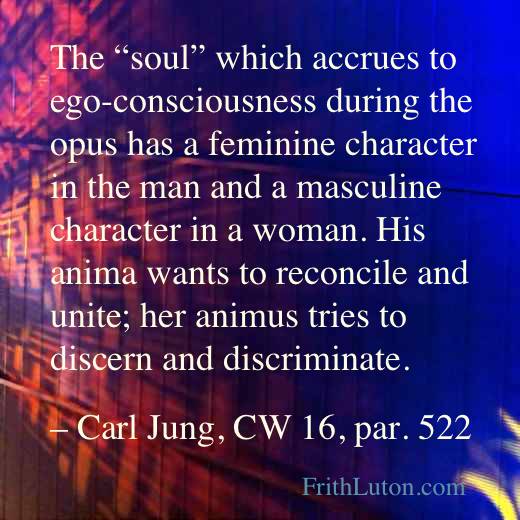
The Anima and Animus are thought to be within our subconscious. It is our balance of "good and evil", the difference between our inner and outer selves, etc. It is the idea of the "soul". It is more comparable to Freud's idea of the Ego. However, Jung differs in that his approach is a balance of male and female energies versus just a simply filter between our rational and basal needs. The animus wants to unite shadow and self, whereas the female anima keeps the animus from allowing the two to bridge completely.
The Self also comparable to Lacan's The Real the combination of all our aspects that integrates within the universe. We never really understand it, but we sense that we are interlinked to other people, and that sense is what conforms us to one another. It could be argued that when one achieves this state they have passed through to the Matrix (pop culture reference) or Nirvana and have found their complete conscious/unconscious balance.
The bridge of the The Ego separates the these from our conscious selves that Jung has deemed our Persona. The Persona is made up of different "masks" that we wear in order to appear a certain way to other people and is not who we are, but best represents the when, why, how and pieces of the what we are.
In less extreme examples, we change. Our personalities or masks vary from situation to situation. The way someone presents themselves to an employer is far more different then how they will be around their friends, which differs from family, etc. We are a collected set of professional, personal, and private lives. We hide the things society may see as less desirable, and put forth what we think people want to see. The same goes for social media. We hide things we don't want everyone to see through privacy settings, and there has been a fair amount of people taking down some networking sites to avoid what they think their employers may see. There are professional sites like LinkedIn to make us seem more attractive to new job possibilities. Twitter, Facebook, dating sites, fetish websites, they are all being used to attract different types of people and to advertise ourselves to the world.
However, you wouldn't post that you have a foot fetish on your Facebook or LinkedIn unless you are going for a certain type of job that requires you to have such a fetish, but you also probably won't post all of your ideas for updating your Linux system to your drinking buddies unless they are also your tech friends.
All that being said, Jung's theory of the Persona, and archetypes argue that we hide parts of ourselves to appear a certain way, and with the development of new technologies people are having to tread more lightly with these ideals because they can cause us to destruct with an over sharing of whatever we choose to put online. The point is, we have to be discriminate and know who we are before we decide to post about what we are.
Thursday, October 2, 2014
The Ultimate Link: Semiotics and Marketing
Semiotics, where we derive meaning from symbols and the relationships we have within our culture, religion, feeling of nationalism, etc. Semiotics worm their way into our minds and can be used to influence us to go one way or another. So, what could this have to do with marketing?
EVERYTHING
In marketing, the whole point is to sell to the masses. There is only one way in which this possible, and that is to understand who your target is.
Example (women):
 Just throwing this one out here. Nail polish, there are many different types and some appear to be better than others, but what does this one particular ad "say" to a consumer? Exclude the nail polish (signifier) and look at everything that is pointing to it. There is, quite obviously, a set of script letters that state "Nail Polish Love" which draw your eyes in not one, but three directions. On either side of this script are "shiny objects" one of which just so happens to be an engagement ring. The bright piece of this, interestingly enough, is the woman's slightly curved lips that are just close enough to a smirk. Now, people may disagree with my assessment on this, but any and every time I see slightly curved lips, I see the "I am better than you" smirk with just a hint of a challenge or secrecy. This whole ad points to the idea that this nail polish either makes this woman better than you because she is loved or has love due to this polish OR that you will get love if you love on this polish.
Just an example of how marketing ploys sort of target the baser human needs to be loved and to accept a challenge from some unknown "superior".
Marketing thrives on the use of semiotics. Morgan Spurlock exemplifies how this happens on TedTalks.
Enjoy if you choose, it is about a twenty minute video, and he goes through how and why some advertising works versus why others do not.
I leave with this thought: Advertising+no semiotics= No ads, no sell point, no nada.
EVERYTHING
In marketing, the whole point is to sell to the masses. There is only one way in which this possible, and that is to understand who your target is.
Example (women):
Just an example of how marketing ploys sort of target the baser human needs to be loved and to accept a challenge from some unknown "superior".
Marketing thrives on the use of semiotics. Morgan Spurlock exemplifies how this happens on TedTalks.
Enjoy if you choose, it is about a twenty minute video, and he goes through how and why some advertising works versus why others do not.
I leave with this thought: Advertising+no semiotics= No ads, no sell point, no nada.
Subscribe to:
Posts (Atom)