I was nervous as all get out about going into presenting my Capstone. I had horrible feelings like "I am not good enough", "People are going to hate this" and "What am I even doing here? Is this ENOUGH?". I called family members and a few friends. My Dad instantly answered his phone and told me that all of my doubts were in my head and that he was proud of me, and that I COULD do this, how could I not, and that he knew my project was great because my sister called him to tell him it was. So, I did what any Harman would. I breathed, invited him to the show, and set up.
After that, the whole thing felt amazing. I loved presenting the game to new people. Riddles and Wonder seemed to be a great hit. After looking back on it all, I think going with quizzing people was a really cool route. Some people seemed to be really into what I had done and asked about plans for web or app based idea, and I thought that it could be very easily done, and if I could, I would. I think I may actually pursue such an idea when there is more time. Dr. Kushin asked me another great question as well. "What advice would I give to someone designing a game?" My answer seemed to take him aback just a bit. I told him..."Design the game you want with keeping the client in mind. You are designing a project that you need to be proud of, but what your consumer also wants." In the end, it is ultimately what you want splashed with what your consumer needs. That's about it. I had a blast doing this, but I truly wish that I had had more time to give it. I think a lot of the class probably feels the same way, but you deal with what you're dealt. I would have also taken a lot more time to sleep and talk with my director. Monica, you are a wealth of information, a strong leader, and I have so much respect for you.
Sunday, April 19, 2015

Last Part of the Trip
I went to the American Art Museum to check out an exhibit that sounded pretty awesome. The Artistic Journey of Yasuo Kuniyoshi was an artist I really hadn't heard of, but when I stopped for lunch at Fado's Irish Pub on 7th and H, I overheard someone talking about it and decided, why not? So, I took the Metro over and went to check out some art. I actually really enjoyed the work that was there. I mean, I'm not generally into that particular style, but I found that it was enjoyable because of that simple fact. The WWII work was emotionally effective. There was a piece, Torture, that just made me stir. I was amazed at the depth that it was able to penetrate into my psyche. It is still in my mind and I saw the exhibit days ago.
DC Part 2
Continuing my journey in DC, I went to look at the photo gallery of George Carlin. I LOVED George Carlin thanks to my parents bringing me up on his comedy. He was so charismatic and blunt. I always look to either him or Ray Steven's work when I need a pick-me-up. I know he wasn't exactly "cultural" but to see some of the pictures from when he started to when he was towards the end of his career ... was just... awe inspiring. The public was aware of some of what he dealt with in his private life, but it makes me wonder what demons he dealt with because some of the most amazing people have some of the hardest things to overcome. RIP George Carlin, and thanks for the laughs.
DC Trip 1
I went to DC to check out the Smithsonian Exhibit on Orchids. Although I have no particular interest in flowers, Orchids are really pretty and this seemed like an interesting exhibit to look at. I tried to go on a day where there wouldn't be a lot of people, and I wish, I wish I had brought a camera to take pictures, but unfortunately I had gone without even taking my phone (it was a spur of the moment Thursday thing) However, I will say that there were so many gorgeous Orchids that it messed with my allergies a bit. Even in the middle of March the blooms were superb. I am so glad I went, and I would go again. I actually might since there is a week left for the exhibit. I would say go on a weekday if anyone is thinking about going, especially since curators seem to be more willing to give more personalized attention to those who are really into the flowers and science behind them.
Home
My friend, Kyle, and I went to see the movie "Home". It was adorable! It also had a pretty important message or two. One, you don't know the effect we are having on the world or worlds around us, and that when push comes to shove, people (and aliens) can be pretty resilient when need be. I actually loved some of the minor hints at adult humor. If asked, I would say that it is a movie I would consider buying when it comes out. It would be nice to just have around for gray days and for when the nieces and nephew visit. Also, cats are vibrating piles of awesome that make Jim Parsons' character unsure of why humans enjoy pet things. It was a great mesh of voices between Jim Parsons OCD like twitchiness and Rhianna's carefree happy determination. Again, I would fully recommend this film!

Capitals Game

Wednesday, April 8, 2015
Casino Work and Dress Code
Casinos have fairly strict policies as to what people wear and why. In the Finance Department, we are required to wear one of two uniforms which were discussed in the last blog. However, I will mention that each section of the rest of the casino wear distinguishing uniforms. For example: dealers (both poker and table games (they are very different yet similar)) wear black shirts with gold trim, black pants and sneakers and most have small aprons with pockets for varying reasons. Slot attendants wear red shirts and are very easily identifiable. Security guards wear mostly wear gold or blue blazers with black shirts, and can be pretty intimidating. Most people that work in the food court wear rust orange shirts, and so on. Why am I mentioning this?
Well, the saying that "the clothes make the man" is not very prevalent in the casino world unless you account for 2 areas. In every area of the casino except for cocktail servers and those that work in the H Lounge, we all pretty much look alike. Males and females wear the exact same clothing and those clothes are not so much a costume as a cover up. What does this say to guests? Well, to me, the translation is: we are all approachable, we are a unit, and we are here not to show off, but to assist and be out of the way. I don't mean this to be negative, but in support of the fact that we are not the focus of the guests. The guests choose those they want to entertain them.
Now, those in the cocktail serving areas as well as the H-Lounge Bar are part of the entertainment. The women do wear costumes: skirts, halter tops, jackets (if need be) and shoes that have some sort of heel. The H-Lounge women wear short shorts, halter vests and shoes with a heel and most wear either fishnets or bare legs. These people do compete for tips, guests, etc, but they also work to help one another in the back. What guests rarely see are these people washing glasses together, mixing drinks for one another and giving support to each other when they need it.
Each area of the casino is like that. There is a network, a team, a unit, that supports one another and will help to warn each other of trouble going on. If guests see anyone in uniforms differing from these conventions, it is safe to say that they are looking at people that need to be very identifiable such as leads, supervisors or managers. Our uniforms do the same for guests: We are here to help, we are identifiable, and we are here for you and each other.
Introduction: Welcome to HCCTR
When I applied to Hollywood Casinos at Charles Town Races, I honestly did not think that it would have much to do with my major in Communication and New Media, but I was wrong. How wrong was I? Well, after taking Media Studies with Kevin Williams last semester, I was about as wrong as anyone can get.
Before I get into that, let me break down what my job entails at the casino, because there are several areas that people don't see unless they work there. Originally, I was hired as a Cage Cashier/Window Attendant. These are the people the public sees and primarily deal with. Our uniform consists of a gold shirt with black trim, black pants and black sneakers/comfortable shoes. Full time employees work 10 hour shifts, 4 days a week, and I will not disclose money amounts. I will say that we are paid above minimum wage and we are able to receive tips.
However, there are 4 "background jobs": TR, Revenue, Chip Bank, and Main Bank. Each of them consists of the same uniform: blue polo shirt, black pants and black sneakers. Outside of the Cage, I work in TR (Ticket Redemption) which deals with the machines on the floor that scan tickets from slot machines and will also break down large bills into smaller denominations.
I was trained in Revenue briefly and Main Bank and Chip Bank are on my list, but I haven't been trained in them, yet. I do know some of what they involve. They will be discussed as they come up through this blog series.
This is a brief overview of the job(s), but it still begs the question: What does this have to do with Communication? In the next 9 blogs, there will be an in depth exploration as to how Communication and New Media directly translates into a job at the Casino.
Sunday, March 29, 2015
Faculty Review
My faculty review was interesting. It helped me see the flaws in my game design, and it gave me a few ideas as to how I can continue in the field with this game and others that I have ideas for.
Monday, March 23, 2015
Progress
I am excited to say that I believe that Riddles and Wonder is as close to ready as it will ever be. The beta test with my sister’s children went over surprisingly well, and they are younger than the intended age group. Even though the math problems were a little bit difficult, they still kept trying and wanted to keep my beta format. Ava, the older of the two, ended up playing the game on her own for a bit. I asked her why, and she just kept saying “I want to keep trying to make more money!” So, for her, it was about the shiny coins and trying to figure out problems, but it was really amazing to watch her light up and not see it as just math problems.
There was a note that my sister, the teacher, made and that was “This needs to look more professional, laminated maybe. Also, will I be able to increase the level of difficulty for my students if I wanted to? Say, I find that there are too many penny questions and not enough nickel or quarter ones, could we increase that?” Of course I could increase that, and I could make it so that it was less difficult by adding more penny spaces.
Another question she asked was about length of game play. If she could increase it, how would she. The response for that was simple “Increase the amount of money you want your kids or students to earn in the game, or decrease it so that it gets them to the ‘dragon’ quicker.”
We also discussed about increasing the difficulty through other forms of math (decimal places, multiplication, division, etc) and she mentioned about doing different levels of the game for other classes.
I believe that having my sister, the teacher, around has greatly improved what I can do with this game and how to help it move along. Not only has this given me a better sense of where I should be, but where this game could be going. Now, all I really need to do is get this thing to Staples and have 2 days where it gets laminated and put on a special board. Maybe one day I will have special figurines to go with it instead of Wal Mart farm animals, but for now, it will suffice.
Sunday, March 1, 2015
Progression of Riddles and Wonder
My game is now officially titled! Riddles and Wonder also has a marked layout and questions. I am not as far along as I would like to be, but the progress is there and it is becoming the game that I want it to be. Testing starts later this week, and I hope that people that are beta testing it, are able to help me hash out the minor details that need fixing.
Sunday, February 15, 2015
Classroom Play: Guidelines and Results
Mary, B. (2010). Bringing Play Back to the Classroom: How Teachers Implement Board and Card Games Based on Academic Learning Standards. Proceedings Of The European Conference On Games Based Learning, 13-18.
In terms of gaming and learning in the early school environment (K-5 in particular) can games be used to help or are they more harmful to the learning environment? Although this was a small article that did a basic overview, I found it extremely helpful to base guidelines for what teachers may need in standardizing gaming while in the classroom. It also helped by providing the feedback from both teachers and students while it documented the overall change in attitude towards using games while in the classroom.
The guidelines were simple enough:
This has narrowed the focus for me in my own project for things to look for in design:
In terms of gaming and learning in the early school environment (K-5 in particular) can games be used to help or are they more harmful to the learning environment? Although this was a small article that did a basic overview, I found it extremely helpful to base guidelines for what teachers may need in standardizing gaming while in the classroom. It also helped by providing the feedback from both teachers and students while it documented the overall change in attitude towards using games while in the classroom.
The guidelines were simple enough:
- Teachers chose either board or card games to fit within an established budget
- Games needed to be easily played in twenty minutes and at least once a week
- After teaching the game, teachers needed to be more hands off and there as moderators.
- Teachers were also asked to keep weekly journals about how they and their students were responding to the introduction of gaming in the classroom, did it meet their needs for academic progress, adjustments to the games to better fit their learning, and they had to meet monthly to discuss how the progress was going.
This has narrowed the focus for me in my own project for things to look for in design:
- Can it be played in a certain amount of time with ease?
- Can it be easily taught?
- Will teachers be able to adjust it so that it becomes more challenging or not?
- Is it going to be easily translated from the classroom to other areas of both students' and teachers' lives?
Sunday, February 1, 2015
Mapping the Design
Ahmad, R., Lahonde, N., & Omhover, J. (2014). GAME METHODOLOGY FOR DESIGN METHODS AND TOOLS SELECTION. Journal Of Learning Design, 7(1), 1-9.
This article is fascinating to me. Basically, it is a great overview as to how designing a game can be approached through a particular methodology. The authors discuss DG: MOTS or Design Game Matrix of Tool Selection which gives a step-by-step process from beginning to end on starting ideas all the way through to validation of design and marketing. It also diagrams it out and challenges the reader to make sure that this method is appropriate for them.
In all honesty, this article appears well written, useful on the basis that the logic appears sound, and it is current enough that it isn't obsolete by any standards. The diagrams will be printed and pinned up as reminders for personal use and mapping out a time line to better get on track for projects that are current and planned for the future.
Sunday, January 25, 2015
Educational Gaming: Issues and Solutions
Chmiel, M. (2012). Learning about the game: designing science games for a generation of gamers. Cultural Studies Of Science Education, 7(4), 807-812. doi:10.1007/s11422-012-9428-9
The above article is an excellent read on the fine line between educational gaming and how it can become, dare I say it, too fun and thereby becomes too much of a game. There is a line, and as game makers, there is a certain obligation to make sure that it stays educationally relevant. In this paper, the game makers created a roller coaster based video game that, after a certain amount of time, became so fun that gamers were looking to try and find a weakness to exploit. Of all things, Google may the weakness easily exposed and therefore allowed gamers to exceed common expectations.
So, why does this matter, and should I really be worried about it with my own research into the gaming world?
Of course it matters to me, even with second graders. Currently there seems to be an influx of technology berating children on a daily basis and making technology faster, more readily available and far more advance than it was even in "my day". Granted, the only real technology available to me in the second grade was ... I believe Windows 95 and my family did not own a computer, let alone half of the stuff my nieces and nephew have come to play with.
As a game designer, I face the same problem that teachers face: kids are getting smarter and more manipulative as the technology advances. It astounds me at how quickly kids can find loopholes into everything. I believe this is why I have decided to go by way of a board game, and by first assuming they are at least somewhat innocent for the first test. After the first test, the exploits and main loopholes can be found and resolved.
I found this article to be extremely useful for how I plan on carrying out my plan to design and define my game. I don't want some crappy boring flash card sort of game, but I also want it to hold the educational aspects that teachers and parents are going to want for their children. Hopefully it will find that border, stay there and still be relevant, at least for a bit before the kids end up getting too smart.
Wednesday, January 14, 2015
Statement of Intent: Capstone Game Design
For my Capstone Project I plan on creating an educational game for children. Monica has agreed to be my Director. I plan on working in the gaming industry after graduation, and hopefully having these prototypes and at least one functional game will provide me with the ways forward.
After researching standards across states and designing a few prototypes. Currently the ideas are surrounding counting, money, and fairy tales. My plan is to further research the current curriculum in Maryland and West Virginia for students in the K-5 range and to make sure that I cover more than just basics for these kids. I plan on going to two different schools for testing, Shepherdstown, WV and Maugansville, MD Elementary schools. I want to see if there is a difference in a few areas including: ways children are being taught, are there separate focuses, and if these differences make a huge impact at those ages.
I also want to try and convert some of these games into applications for tablets and phones. I figure, if technology is changing, education can't be too far behind and therefore, so should these games. That means that there should be companion applications for at least one of these games. However, my goal is to have at least 3 working games and letting the children decide which one they like best.
Right now, the idea for my first game is for at least 2 children, and it will be turn based. It will combine both math and fairy tale-like creatures. I'm not sure if dice will be included or if it will be card based. I plan on working closely with teachers in both schools to better formulate these games and to see the mindset of the children. I look forward to the challenges of creating educational games because sometimes they do come off as dry and unappealing. My main goal is to keep the education, but keep it fun too.
Sunday, November 30, 2014
Jung, Superheros and Us
Lewis Carroll once wrote "“I wonder if I've been changed in the night? Let me think: was I the
same when I got up this morning? I almost think I can remember feeling a
little different. But if I'm not the same, the next question is 'Who in
the world am I?' Ah, that's the great puzzle!” in his book Alice in Wonderland.
In comparison, Carl Jung had said "It all depends on how we look at things, and not how they are in themselves".
One may wonder how the two are related, and the answer is quite simple: as human beings, we are bound to look at ourselves and wonder who we are, what we are, and why we are. There is always some level of self examination, but this blog is to focus on the who we are when we are in certain situations. Jung argued that there are at least four archetypes that human beings exhibit: The Persona (conscious), followed by the unconscious: Shadow, Anima and Animus, and Self. There is also the ego/bridge between the conscious, which is the mediator between what we are versus who we are. Very quickly, the follow is an overview of each Jung's unconscious.
The Shadow is our unconscious, the side that we know about but that we really don't know. It is what stays below our conscious, and keeps our "true feelings" hidden. Carl Jung argued that the Shadow presented itself in our dreams, both night and day, and that if we were to embrace it, there would be harmony, but shun it and we become split. Some may argue that conscious manifestations of the Shadow are in dazed, confused, or panic attack type states when the Shadow can readily move between states of self.


The easiest way to describe what Jung was describing when it comes to Masks would be to talk about the modern Superhero. There are several examples, but let's take a look at Rorschach from the Watchmen. He is a character who believes that his face is the mask he wears. He exemplifies the quote from Lewis Carroll above when he describes his transformation from Walter Kovacs into Rorschach as seen in this video (WARNING, this is GRAPHIC)
In comparison, Carl Jung had said "It all depends on how we look at things, and not how they are in themselves".
One may wonder how the two are related, and the answer is quite simple: as human beings, we are bound to look at ourselves and wonder who we are, what we are, and why we are. There is always some level of self examination, but this blog is to focus on the who we are when we are in certain situations. Jung argued that there are at least four archetypes that human beings exhibit: The Persona (conscious), followed by the unconscious: Shadow, Anima and Animus, and Self. There is also the ego/bridge between the conscious, which is the mediator between what we are versus who we are. Very quickly, the follow is an overview of each Jung's unconscious.
The Shadow is our unconscious, the side that we know about but that we really don't know. It is what stays below our conscious, and keeps our "true feelings" hidden. Carl Jung argued that the Shadow presented itself in our dreams, both night and day, and that if we were to embrace it, there would be harmony, but shun it and we become split. Some may argue that conscious manifestations of the Shadow are in dazed, confused, or panic attack type states when the Shadow can readily move between states of self.

The Anima and Animus are thought to be within our subconscious. It is our balance of "good and evil", the difference between our inner and outer selves, etc. It is the idea of the "soul". It is more comparable to Freud's idea of the Ego. However, Jung differs in that his approach is a balance of male and female energies versus just a simply filter between our rational and basal needs. The animus wants to unite shadow and self, whereas the female anima keeps the animus from allowing the two to bridge completely.
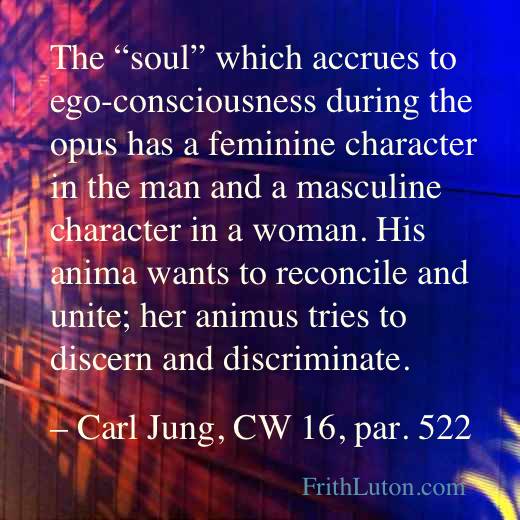
The Self also comparable to Lacan's The Real the combination of all our aspects that integrates within the universe. We never really understand it, but we sense that we are interlinked to other people, and that sense is what conforms us to one another. It could be argued that when one achieves this state they have passed through to the Matrix (pop culture reference) or Nirvana and have found their complete conscious/unconscious balance.
The bridge of the The Ego separates the these from our conscious selves that Jung has deemed our Persona. The Persona is made up of different "masks" that we wear in order to appear a certain way to other people and is not who we are, but best represents the when, why, how and pieces of the what we are.
In less extreme examples, we change. Our personalities or masks vary from situation to situation. The way someone presents themselves to an employer is far more different then how they will be around their friends, which differs from family, etc. We are a collected set of professional, personal, and private lives. We hide the things society may see as less desirable, and put forth what we think people want to see. The same goes for social media. We hide things we don't want everyone to see through privacy settings, and there has been a fair amount of people taking down some networking sites to avoid what they think their employers may see. There are professional sites like LinkedIn to make us seem more attractive to new job possibilities. Twitter, Facebook, dating sites, fetish websites, they are all being used to attract different types of people and to advertise ourselves to the world.
However, you wouldn't post that you have a foot fetish on your Facebook or LinkedIn unless you are going for a certain type of job that requires you to have such a fetish, but you also probably won't post all of your ideas for updating your Linux system to your drinking buddies unless they are also your tech friends.
All that being said, Jung's theory of the Persona, and archetypes argue that we hide parts of ourselves to appear a certain way, and with the development of new technologies people are having to tread more lightly with these ideals because they can cause us to destruct with an over sharing of whatever we choose to put online. The point is, we have to be discriminate and know who we are before we decide to post about what we are.
Thursday, October 2, 2014
The Ultimate Link: Semiotics and Marketing
Semiotics, where we derive meaning from symbols and the relationships we have within our culture, religion, feeling of nationalism, etc. Semiotics worm their way into our minds and can be used to influence us to go one way or another. So, what could this have to do with marketing?
EVERYTHING
In marketing, the whole point is to sell to the masses. There is only one way in which this possible, and that is to understand who your target is.
Example (women):
 Just throwing this one out here. Nail polish, there are many different types and some appear to be better than others, but what does this one particular ad "say" to a consumer? Exclude the nail polish (signifier) and look at everything that is pointing to it. There is, quite obviously, a set of script letters that state "Nail Polish Love" which draw your eyes in not one, but three directions. On either side of this script are "shiny objects" one of which just so happens to be an engagement ring. The bright piece of this, interestingly enough, is the woman's slightly curved lips that are just close enough to a smirk. Now, people may disagree with my assessment on this, but any and every time I see slightly curved lips, I see the "I am better than you" smirk with just a hint of a challenge or secrecy. This whole ad points to the idea that this nail polish either makes this woman better than you because she is loved or has love due to this polish OR that you will get love if you love on this polish.
Just an example of how marketing ploys sort of target the baser human needs to be loved and to accept a challenge from some unknown "superior".
Marketing thrives on the use of semiotics. Morgan Spurlock exemplifies how this happens on TedTalks.
Enjoy if you choose, it is about a twenty minute video, and he goes through how and why some advertising works versus why others do not.
I leave with this thought: Advertising+no semiotics= No ads, no sell point, no nada.
EVERYTHING
In marketing, the whole point is to sell to the masses. There is only one way in which this possible, and that is to understand who your target is.
Example (women):
Just an example of how marketing ploys sort of target the baser human needs to be loved and to accept a challenge from some unknown "superior".
Marketing thrives on the use of semiotics. Morgan Spurlock exemplifies how this happens on TedTalks.
Enjoy if you choose, it is about a twenty minute video, and he goes through how and why some advertising works versus why others do not.
I leave with this thought: Advertising+no semiotics= No ads, no sell point, no nada.
Tuesday, September 23, 2014
Kids, Games, and Learning
Article 1: The Games Children Play by: Nancy Padak and Rasinski
Padak, N., & Rasinski, T. (2008). The Games Children Play. Reading Teacher, 62(4), 363-365.
Description of different word games that children can play to enhance their vocabulary. The writers explain that these are supposed to be for both children and their parents and that parents need to remember to not make the games “should never frustrate the children”, but “light and enjoyable” (Padak, Rasinski 2008) There are actually 12 that are discussed, and some of which sound kind of fun. One of my favorites reminds me of what happens in J.R.R. Tolkein’s The Hobbit. It uses riddles to come to a word conclusion. This does not include “What is in my pocket?” The article concludes with the idea and research to back their idea that game play is more effective in teaching children than just helping kids with their homework. According to their sources, game play makes children and parents active learners.
Article 2
Promoting Language Arts: Through Vocabulary Development with Internet Resources in the Elementary Classroom by Edward J. Lazaros
Lazaros, E. J. (2012). promoting language arts through vocabulary development with internet resources in the elementary classroom. Children's Technology & Engineering, 17(1), 10-13
The basis of this article was just an overview as to how the Internet can be used as a resource to help children improve their language arts skills. Using the research based on Jalongo and Sobolak, the author breaks down how the Internet is not a hindrance on children’s learning, but if pointed towards the right direction and the right sources, it can be a very big help when it comes to learning. He makes the argument that the more actively engaged in the learning process a child is, the more they will retain and the better they will do in the classroom. He also gives free resources and explains that as children are growing up in the technology era, they need to be able to use it and utilize it in their world. He concludes with how these sources can be incorporated throughout a child’s learning process and in the classroom. Basically, teachers need to embrace children learning through technology, not shun it.
Article 3: Teaching Tips: Using Theater Games to Enhance Language Arts Learning by Sharon Fennesey
Fennessey, S. (2006). Using theater games to enhance language arts learning. Reading Teacher, 59(7), 688-691. doi:10.1598/RT.59.7.7
Using her own research to support her thesis, Fennesey (2006) states, “From my viewpoint, drama is a time for my students to enrich their language arts learning in an exciting and pleasurable way.” She goes through five different dramatic games that all help to enhance children’s way of speaking. It enhances their learning and it can be really fun. It’s learning through art.
Article 4: Games, Gamers and Gaming: Games and Writing by Liz Danforth
Danforth, L. (2009). Games and Writing. Library Journal, 134(17), 54.
This article basis the idea that gamers are not unimaginative drones that just "hang out" and play video games all day. Quite frankly, it challenges the idea and makes the argument that instead of letting these notions take over, it makes more sense to try and open the worlds that gamers experience so that their skills also improve. Using the idea of Fanfiction to create stories that people actually want to write about versus what they have to write about. This allows for students to write about what they care about, teachers something to critique and look at their students' creativity and it also lessens boredom (at least, it should).
Article 5: Fighting Baddies and Collecting Bananas: Teachers' Perceptions of Games-Based Literacy Learning
Gerber, H. R., & Price, D. P. (2013). Fighting baddies and collecting bananas: Teachers’ perceptions of games-based literacy learning. Educational Media International, 50(1), 51-62. doi:10.1080/09523987.2013.777182
This is an overview as to how learning for children has changed with the integration of video games. Out of all of the participants (who were masters and doctoral students who were employed as school teachers) only two considered themselves "gamers" and the study focused on what teachers perceived to be the best way to possibly integrate virtual and video based games into their classrooms. The participants then discussed possible difficulties in involving games into their classrooms. These difficulties included funds, classical writings no longer being a part of the curriculum, and a resistance to change amongst staff members. All in all, a dry read, but it points out the uncommon challenges being faced in a technological world versus the traditional one.
Article 6: FunBrain Language Arts Games
Mandell, P., & Minkel, W. (2004). FunBrain Language Arts Games. School Library Journal, 50(6), 61.
This is just an overview of games currently available for teachers and students alike. They seem fun enough and the article breaks them down by grade ranking. However, I find that they are lacking in something that makes kids/teens want to play them.
Overall, these articles are all insightful. I think I may now have a better understanding as to where and how to make an educational game better and more suited for people that makes them want to learn and want to play. There are several factors that need to be assessed, and I can't wait to see what is going to happen.
Wednesday, September 3, 2014
Hermeneutics: All Around Us
Hermeneutics, what is it? Why is it that every time I stop to think about the word, the first thought is "for a word that is the study of interpretation, why is it so hard to spell"? Then, it hit me. If someone were to say that word to five people, it is very likely that there would be five different spellings, but not because it is a difficult word to spell, but because how we hear words and have different ways of spelling them. Think about it, off hand there is the instant breakdown of "Her-men-oo-tics", or "Her-man-u-ticks" among the several variations, and believe it or not, this actually has a point.
The first of the five Hermeneutics that will be discussed is Natural. What has been described above is a very over generalized and rough idea as to what is meant by Natural Hermeneutics. Put simply, it is how people interpret the world around them. Most of the time it seems simple, almost meaningless, until it is put into context. Think about any event that was experienced with other people and then try and see that same event from someone else who was there. Even better, think of how someone who is being told about that event could be interpreting it.
The second of these Hermeneutics is Normative. Doctors, lawyers, etc more known as people who understand a technical language and make it so "regular people" can understand it. Example: you go to your doctor and tell them of your symptoms. The doctor listens, thinks about it, may send you for more tests, but eventually, they come back to you with a diagnosis and treatment plan. Doctors are able to see technical language, interpret it, and relay it to people on an every day basis. Lawyers look at documentation constantly that would make the common man wonder if it were in gibberish, yet when the lawyer talks to man X about what it says, the lawyer can put it into words and sentences that make sense, and when they don't, there are other ways to put it even simpler. In other words, this form doesn't come naturally to people, it has to be worked on and kept on top of.
Scientific Hermeneutics are the basis and foundation for the scientific approach to the world. It is how we look at the world in order to create experiments that lead to answers to the "big questions". Ideas like String Theory, Game Theory, etc come from. Basically, there is a question, and in order to figure out an answer, steps are taken, procedure is followed, experiments are made and then conclusions are come to. If these experiments are repeated and the same results happen, then eventually these results become laws or solidified as accepted rules or facts.
In nearly the completely opposite direction is Philosophical Hermeneutics. These focus on the WHO we are versus WHAT we do. It dives into the idea that we are interpreters and that interpreting is not something we do. In an overly simplified statement "It is not what we do, it is who we are".
Which leads to the idea of Depth Hermeneutics. These are the questions and the interpretations of what is beyond the physical human world. Freud referred to it as the unconscious, others have called it existentialism, and there are more theories as to why we are, what or what else is there to life. This piece of Hermeneutics begs the ideas of souls, afterlives, etc.
This is a fascinating area of study, and there is so much more that can be discussed. This blog will continue to be updated as it feels necessary to look further into these ideas.
Monday, September 1, 2014
Skyrim: Sexism, Racism, Lore and More
The basis for the next blogs are overviews to the Elder Scrolls Series from Bethesda, but with a focus on Elder Scrolls V: Skyrim. As for the premise, I am going over the focus on the religion, and where the idea came from. Also, there seems to very strong distinction between classes, race and the sexes. There is an internal conflict within the series which makes these divides even bigger. If that fails to suffice for ten blogs, then I will begin to dive further into comparing games that are similar to what Bethesda has created, although some would argue that no one has created anything like it.
Subscribe to:
Posts (Atom)